 how-to
Jewellery Appraisal for Family Law: A 2026 Guide
Table of Contents
- Why Family Law Property Settlements Need a Formal Jewellery Appraisal
- Fair Market Value vs Replacement Value Jewellery: What the Court Needs
- How the Family Law Act Treats Jewellery in Asset Division
- Step-by-Step Process for Obtaining a Court-Ready Jewellery Appraisal
- Independent Jewellery Valuation for Court: What Makes It Legally Sound
- Cost of Jewellery Appraisal for Legal Purposes: What Influences the Fee
- Common Disputes and the Second-Hand vs Retail Value Gap
- Final Steps: Using Your Appraisal in Financial Disclosure
- Frequently Asked Questions
Last Updated: September 4, 2026
Why Family Law Property Settlements Need a Formal Jewellery Appraisal
A jewellery appraisal for family law is a formal, documented valuation prepared to meet the evidentiary standards of property settlement proceedings. When a relationship ends, every asset must be identified and valued before the court can divide property fairly. Jewellery is frequently contentious because its worth is not obvious, and informal estimates rarely survive scrutiny.
A proper appraisal can prevent disputes from derailing a settlement. The process is not about assigning a number you hope for; it is about establishing a defensible figure backed by methodology and expert opinion.
This guide explains what the court expects, how the Family Law Act treats your pieces, and the practical steps to secure an appraisal that holds up.
Fair Market Value vs Replacement Value Jewellery: What the Court Needs
Fair market value is the price a willing buyer would pay a willing seller on the open market, which for most jewellery is the second-hand or resale value. Replacement value is the cost to insure and replace the item new from a retail jeweller.
The court is primarily concerned with fair market value because it reflects the realisable asset in a division. Many owners are surprised to learn their engagement ring, purchased at retail, may have a fair market value considerably lower.
A formal appraisal report will often state both figures, but it must clearly identify which valuation methodology was used and why. An insurance valuation alone, which relies on replacement value, is not suitable as evidence for asset division.
How the Family Law Act Treats Jewellery in Asset Division
Under the Family Law Act 1975, the court considers all property of the parties, including personal effects, when determining a property settlement. Jewellery is not automatically excluded as a personal item; it is an asset like any other, and its value is added to the pool for division.
The Act does not prescribe a special rule for jewellery; it falls within the broad definition of property. A wedding ring of modest value may be retained by the party who wears it, but high-value pieces, particularly those purchased as investments or with significant gemstones, are routinely included in the asset pool.
Financial disclosure is mandatory in family law proceedings. Both parties must provide full and frank disclosure of their assets, and failing to declare a valuable piece can have serious consequences. An independent assessment provides a clear record that satisfies this obligation.
Step-by-Step Process for Obtaining a Court-Ready Jewellery Appraisal
Securing a court-ready valuation requires more than a quick visit to a jeweller. The process demands documentation, a qualified professional, and a written report that meets legal standards.
Step 1: Build Your Evidence File (A Practical Checklist)
Before you contact a valuer, assemble a complete evidence file to provide the context needed for a defensible report. Use this checklist:
- Original Purchase Receipts: Even if the price is not indicative of current market value, it establishes provenance and provides details on the piece's specifications (carat weight, clarity, metal type).
- Gemmological Laboratory Certificates: Reports from bodies like the Gemological Institute of America (GIA) or the Australian Gemmological Institute (AGI) provide independent verification of a diamond's 4Cs. This is critical evidence for high-value stones.
- Previous Appraisals: Any prior valuations, even for insurance, help establish a history of the piece's value and can highlight changes in the market.
- Photographs: Take clear, well-lit photos of each piece from multiple angles. Include close-ups of any hallmarks, engravings, or unique identifying features.
- Original Packaging and Boxes: While not essential, these support the item's condition and provenance, particularly for designer pieces.
- Written Provenance: For antique or inherited items, note any known history, who purchased it, when, from where, and any stories of its origin. This can significantly affect value.
- A List of Questions: Write down anything you want to ask the valuer about the process, timeline, or their qualifications.
Organising these items in a single folder demonstrates to the valuer, and later, to the court, that you are approaching the matter with diligence.
Step 2: Vet Your Valuer Like an Expert Witness
The report's credibility rests on the valuer's standing. A court-ready appraisal cannot come from a retail jeweller who may have an interest in the outcome. Use this checklist to vet your candidate:
- Formal Qualifications: Does the valuer hold a diploma or degree in gemmology from a recognised institution, such as the Gemmological Association of Australia (GAA)?
- Professional Membership: Is the valuer a member of a professional body with a code of ethics, such as the National Council of Jewellery Valuers? Membership indicates a commitment to standards and ongoing professional development.
- Independence: Does the valuer have any connection to the sale of the piece, the parties involved, or a retail outlet that could create a conflict of interest? Their fee must not be contingent on the valuation figure.
- Experience in Family Law: Has the valuer previously prepared reports for family law matters? Have they given evidence as an expert witness in court? A valuer who understands the legal process will frame their report appropriately.
- Insurance and Professional Indemnity: Does the valuer carry professional indemnity insurance? This protects you if their report is later found to be negligent.
- Ask for References: A reputable valuer should be able to provide references from family lawyers or previous clients.
A founding member of the National Council of Jewellery Valuers brings a level of authority that is difficult to challenge. An expert witness with decades of hands-on experience will also carry more weight if the matter proceeds to a hearing.
Step 3: Understand the Written Evaluation Process
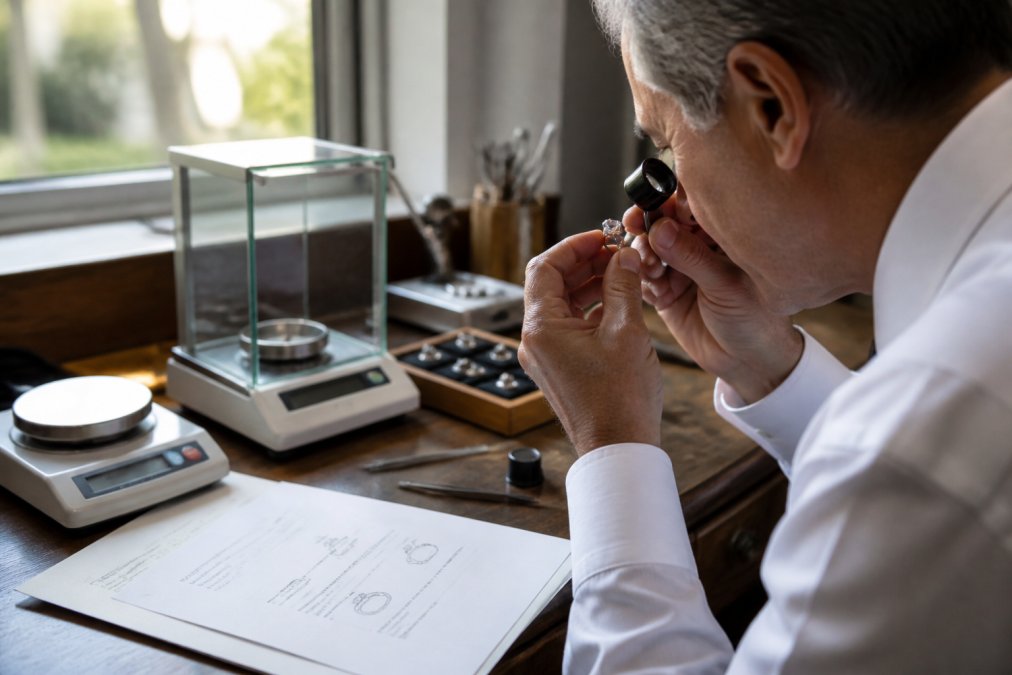
A formal written evaluation is a detailed document, not a one-line figure. The valuer will physically examine each piece, test the gemstones and metals, and research current market conditions, then describe the item, state the methodology, and provide a reasoned conclusion of value.
The process for a single piece typically takes several days; complex items may take longer. Ask your valuer for a timeline before you commit.
Step 4: Review the Report for Accuracy
Before the report is filed, review it meticulously. Check that the description of each piece is accurate, down to the spelling of any engravings, and that the valuation figure and methodology are clearly stated. If you spot an error, raise it with the valuer immediately; corrections are far easier to make before the report is submitted.
Independent Jewellery Valuation for Court: What Makes It Legally Sound
An independent jewellery valuation for court must be defensible on the stand. The report must be prepared by someone who can act as an expert witness, explaining their methodology and conclusions under cross-examination.
The legal soundness of a valuation rests on three pillars: the valuer's qualifications, the thoroughness of the examination, and the transparency of the methodology. The report should reference current market data and explain how the final figure was reached; vague statements about "estimated value" are a red flag.
The court may appoint its own single expert if the parties cannot agree, and that report becomes the primary evidence. A well-prepared independent report can still be used to challenge or contextualise the court-appointed expert's findings.
Cost of Jewellery Appraisal for Legal Purposes: What Influences the Fee
The cost of jewellery appraisal for legal purposes varies significantly based on the complexity of the work. Fees are influenced by the number of pieces, the time required for examination, the need for gemstone testing, and the depth of market research required.
Do not choose a valuer based on price alone. A cheap appraisal that is rejected by the court will cost you far more in delays and legal fees. Conversely, an expensive report does not guarantee quality. Ask about the valuer's experience with family law matters and request a firm quote before proceeding.
For current pricing and a tailored quote, contact Gemmological Valuations of Australia directly. We provide precise, well-documented reports designed to withstand legal scrutiny.
Common Disputes and the Second-Hand vs Retail Value Gap
The most frequent dispute arises from the gap between what a piece cost and what it is worth now. One party often argues for retail or replacement value, while the other insists on second-hand market value. The court will side with the methodology that reflects the true realisable asset.
This discrepancy is particularly acute for engagement rings and branded jewellery. A ring purchased for $10,000 may have a fair market value of only $3,000 to $5,000 on the second-hand market. Understanding this early can help both parties negotiate more realistically.
Why the Value Drops: The Mechanics of the Second-Hand Market
The 25-30% (or greater) drop from retail to second-hand value is not arbitrary. It is driven by several concrete factors that a formal appraisal will quantify:
- The Retail Markup: Retail prices include significant overheads, store rent, staff commissions, marketing, and financing costs. When you buy at retail, you are paying for the jeweller's business model, not just the gold and gemstones. The second-hand market strips away these costs, pricing the item based on its intrinsic materials and desirability alone.
- The 'New' Premium: A piece of jewellery is a manufactured good. Once purchased, it is technically 'pre-owned'. The second-hand market applies a discount for this status, much like a new car depreciates the moment it leaves the dealership. This is true even if the piece has never been worn.
- Design and Trend Risk: Retail prices reflect current design trends. A piece that is fashionable today may be dated in five years, reducing its appeal to a second-hand buyer. Classic designs hold value better, but they still face the retail markup discount.
- Gemstone and Metal Market Fluctuations: The wholesale value of diamonds, coloured gemstones, and precious metals fluctuates daily. A retail price from three years ago may have been based on a higher or lower wholesale cost. The appraiser uses current market data for the second-hand valuation, not the historical retail price.
- The Buyer's Risk: A private buyer on the second-hand market assumes risk. They cannot be certain of the piece's provenance or the accuracy of its gemstone grading without their own verification. This risk is priced into the offer they are willing to make.
Why This Gap is a Flashpoint in Family Law
The emotional context of family law amplifies this financial reality. The party who received the jewellery often perceives its value based on the retail price paid or the sentiment attached, while the other party sees only its liquidation value. A formal appraisal that clearly delineates fair market value and explains the methodology provides an objective anchor, shifting the conversation from 'what it cost' to 'what it is worth in the market today'.
Sentimental value is another flashpoint. A piece inherited from a grandparent may be priceless to one party, but the court must assign a financial value. A professional appraisal provides an objective figure that removes emotion from the equation.
Final Steps: Using Your Appraisal in Financial Disclosure
Once you have your appraisal report, it must be included in your financial disclosure documents. Provide a copy to your solicitor and, if required, to the other party, and file it alongside your statement of assets and liabilities.
Before finalising your settlement, review the report carefully. Ensure the description of each piece is accurate and that you agree with the valuation; if you believe an error has been made, raise it with the valuer immediately.
A formal jewellery appraisal for family law is an investment in a smoother resolution. By securing a court-ready valuation from an experienced professional, you protect your position and give the court the clarity it needs to reach a fair outcome.
Getting a jewellery appraisal right is rarely straightforward, but the consequences of getting it wrong are significant. Delays, disputes, and unfavourable rulings all stem from valuations that cannot withstand scrutiny. Working with a senior appraiser who holds over 50 years of industry experience and is a founding member of the National Council of Jewellery Valuers gives you confidence that your report will be accepted. Gemmological Valuations of Australia provides precise, reliable appraisals for family law, estate, and insurance purposes. Get started with Gemmological Valuations of Australia and secure a valuation that holds up when it matters most.
Frequently Asked Questions
Who keeps the engagement ring after a divorce in Australia?
Under the Family Law Act 1975, an engagement ring is generally treated as a gift, so the recipient typically keeps it. However, in a property settlement, the ring's value can still be included as a marital asset. If the ring is significant, a formal jewellery appraisal may be required to establish its market value for the asset division process.
What is the difference between market value and replacement value in family law?
Market value is what a willing buyer would pay for the jewellery on the second-hand market, often less than the original retail price. Replacement value is the cost to replace the item with a similar new piece. In family law property settlements, the court generally requires fair market value, not replacement value, because it reflects the actual liquid asset available for division.
How much does a jewellery appraisal cost for legal purposes?
The cost of a jewellery appraisal for legal purposes varies depending on the complexity of the piece, the number of items, and the detail required for a court-ready report. Fees reflect the gemmologist's time, testing procedures, and research. Contact Gemmological Valuations of Australia directly for a quote tailored to your specific pieces and legal requirements.
Will the court accept any jewellery valuation report?
No. A court requires an independent jewellery valuation from a qualified, certified valuer with recognised credentials, such as membership in the National Council of Jewellery Valuers. The report must follow a specific methodology, include detailed descriptions and gemstone grading, and be prepared to withstand scrutiny. An insurance valuation or a retail estimate is rarely sufficient for court proceedings.
This article was written using GrandRanker